0878 567 491
 BG
BG 


 Proteins
 Amino acids
 Healthy supplements
 Vitamins and minerals
 Creatine
 Weight loss
 Nitrogen boosters
 Testosterone and growth hormone
 Bars and food
Joint problems have long ceased to be a “privilege” only of the aging population. In today's dynamic everyday life, filled with intensive training or, on the contrary, with sedentary work in front of a screen, stiffness and discomfort are affecting more and more young people.
The approach to long-term mobility should always be comprehensive, with a key element being the intake of the right nutritional supplements. When we talk about musculoskeletal support, we invariably come to the dilemma: collagen or glucosamine?
Both substances are renowned for their beneficial effects on cartilage and joint health, but there is often confusion as to which is more effective. Do they work synergistically, or is one superior to the other? In this article, we will examine the scientific facts to find out which is the best solution for you.
What is glucosamine?
Glucosamine is not just a supplement from the pharmacy, but a natural compound – an amino sugar that our body produces on its own. It is a basic “building block” for cartilage tissue, ligaments and synovial fluid. Its main role is to stimulate the production of glycosaminoglycans – molecules that retain water in cartilage and give it its elasticity and shock-absorbing properties.
However, as we age, the body's ability to synthesize glucosamine progressively decreases, leading to thinning of the cartilage and the appearance of friction and pain.
Its availability in nature is limited, and it is most often extracted from the outer shells (chitin) of crustaceans such as shrimp and crabs.
Its mechanism of action is specific and effective in the long term: glucosamine not only helps repair microdamages in cartilage, but also blocks the enzymes responsible for its premature degradation. In this way, it acts as a biological shield that slows down wear and tear processes and supports the natural regeneration of joints from within.
Collagen or the joints' best friend
If glucosamine is the “lubricant” and protection of cartilage, then collagen is its structural basis. It is the most abundant protein in the human body, which acts as a glue for tissues. In the joints, we mainly find type II collagen, which builds the dense network of fibers responsible for the strength and resistance of cartilage under pressure.
Like glucosamine, the body naturally produces collagen, but after the age of 25, this process gradually begins to slow down. Over time, its deficiency becomes visible not only in the skin, but also in the joints, which lose their elasticity.
Unlike many other proteins, collagen has a unique amino acid profile. When taken as a supplement (especially in hydrolyzed form), this protein delivers specific peptides that signal the body to start producing its own new connective tissue.
Its mechanism of action is straightforward, literally nourishing the cartilage matrix and maintaining the integrity of tendons and ligaments. Without enough collagen, joints become brittle and susceptible to wear and tear, no matter how much “lubricant” is present in them. More about collagen and its overall role in the human body learn here.
What is the main difference between glucosamine and collagen?
Before we look for the difference, we should note that these two substances are “from the same team”. Both collagen and glucosamine are synthesized naturally in our body and are fundamental components of the joint system. What they have in common is that with age, their production progressively decreases, leading to loss of elasticity and discomfort during movement.
The key difference between them lies in the scope of action. Collagen is a universal protein that is present throughout the body and is critically important not only for joints, but also for the strength of bones, skin, muscle sheaths and even blood vessels. Its lack is felt systemically and everywhere.
Glucosamine, on the other hand, is a highly specialized “expert” and is aimed almost entirely at joint cartilage and the production of synovial fluid (joint “lubricant”). Its lack is almost always felt directly in the joints.
When should we take collagen?
Collagen is an excellent choice when the primary goal is to restore the structural integrity of connective tissue throughout the body. Its strength lies in its ability to regenerate the “scaffolding” of joints, providing them with the necessary strength and elasticity under load.
Here are the conditions in which it is more advisable to focus on taking collagen:
- Early stages of joint degeneration or when you feel the first signs of stiffness and loss of flexibility.
- Ligament and tendon injuries – since these tissues are made up primarily of collagen fibers, its intake accelerates their healing.
- Intense sports loads – to protect joints from mechanical wear and micro-trauma in runners and athletes.
- Total bone density – when support is needed not only for the cartilage, but also for the organic matrix of the bones.
- Age-related changes (after 40 years of age) – to compensate for the natural decline in collagen synthesis, which simultaneously affects the joints, skin, and muscle tissue coverings.
When should we take glucosamine?
As we said, with glucosamine, the focus shifts from the general structure of the body to the specific protection and “lubrication” of the joint itself. This makes it the most appropriate choice when the main problem is related to the wear of the cartilage surface and reduced mobility, accompanied by the characteristic “friction”.
Here are the specific conditions in which taking glucosamine is highly recommended:
- Osteoarthritis and arthritic changes: the gold standard when choosing a supplement, as glucosamine slows down the destruction of cartilage in the knees, hip joints, and spine.
- Recovery after joint surgeries – supports faster healing of specific cartilage areas that have limited blood supply and need direct “nourishment”.
- Chronic joint pain and inflammation – glucosamine has a mild anti-inflammatory effect that helps manage constant discomfort during movement.
- Feeling of “dry” joints – when you feel cracking, clicking or stiffness in the morning, glucosamine helps restore the viscosity of the synovial fluid.
- Thinning of the articular cartilage - when diagnosed with wear and tear (due to age or heavy physical labor), it acts as a protective layer that absorbs the load.
Glucosamine and collagen – tips for optimal absorption
To get the most out of collagen or glucosamine, it's not enough to simply choose a quality product, but also to create the right environment in the body for their full metabolization. The absorption of their complex molecules depends on a number of factors that determine whether they will reach the cartilage or simply transit through your digestive system.
One of the most important catalysts for collagen synthesis is the presence of vitamin C. Without it, the body cannot convert ingested amino acids into healthy joint fibers, so always combine supplements with antioxidant-rich foods or pure vitamin C.
Another key point is hydration, as glucosamine works by attracting water into the cartilage matrix. If the body is dehydrated, its effect on joint lubrication will be severely limited.
Timing of intake also affects results. It is recommended that collagen be taken on an empty stomach or at least 30 minutes before a meal to avoid competition with other proteins in the stomach, while glucosamine is often better tolerated and more steadily absorbed during meals.
Last but not least, physical activity is mandatory, as joints do not have their own blood supply and rely on movement to "suck up" nutrients from the synovial fluid.
Collagen or glucosamine – why not both?
This powerful combination is especially recommended for advanced degenerative processes, where there is both loss of cartilage mass and reduced mobility.
If you suffer from chronic discomfort that interferes with daily activities, or are recovering from a serious sports injury, joint use will speed up regeneration significantly more than if you choose a single-component supplement.
For older people, the dual approach often proves to be a particularly useful strategy, as it supports the body in two directions simultaneously - by supplying structural elements and by maintaining joint hydration.
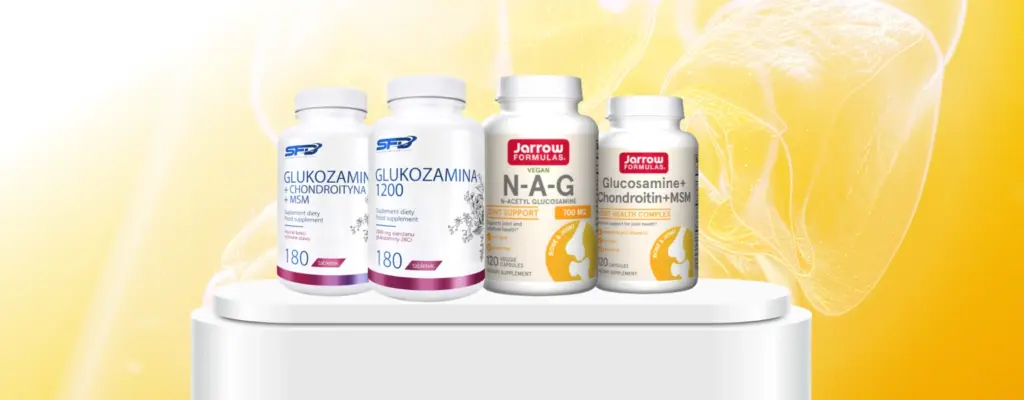
The right solution for activity and comfort
Ultimately, the choice between collagen and glucosamine is a matter of your body's individual needs.
If your goal is to strengthen the overall structure of connective tissue and restore elasticity to the body, добавките с колаген са вашият пръв помощник. Ако обаче се борите с триене, скованост и износване на хрущяла, glucosamine supplements will provide the necessary protection and hydration.
It's important to listen to the signals your joints are sending you and approach their health with care and consistency. Whether you opt for a single supplement or a powerful combination of two supplements, the right choice starts with quality ingredients and proven provenance.
MaxLife has a diverse selection of nutritional supplements specifically designed for здравето на ставите. Тук ще откриете прецизно селектирани формули, които ще ви помогнат да запазите своята активност и радост от движението във всеки етап от живота.